


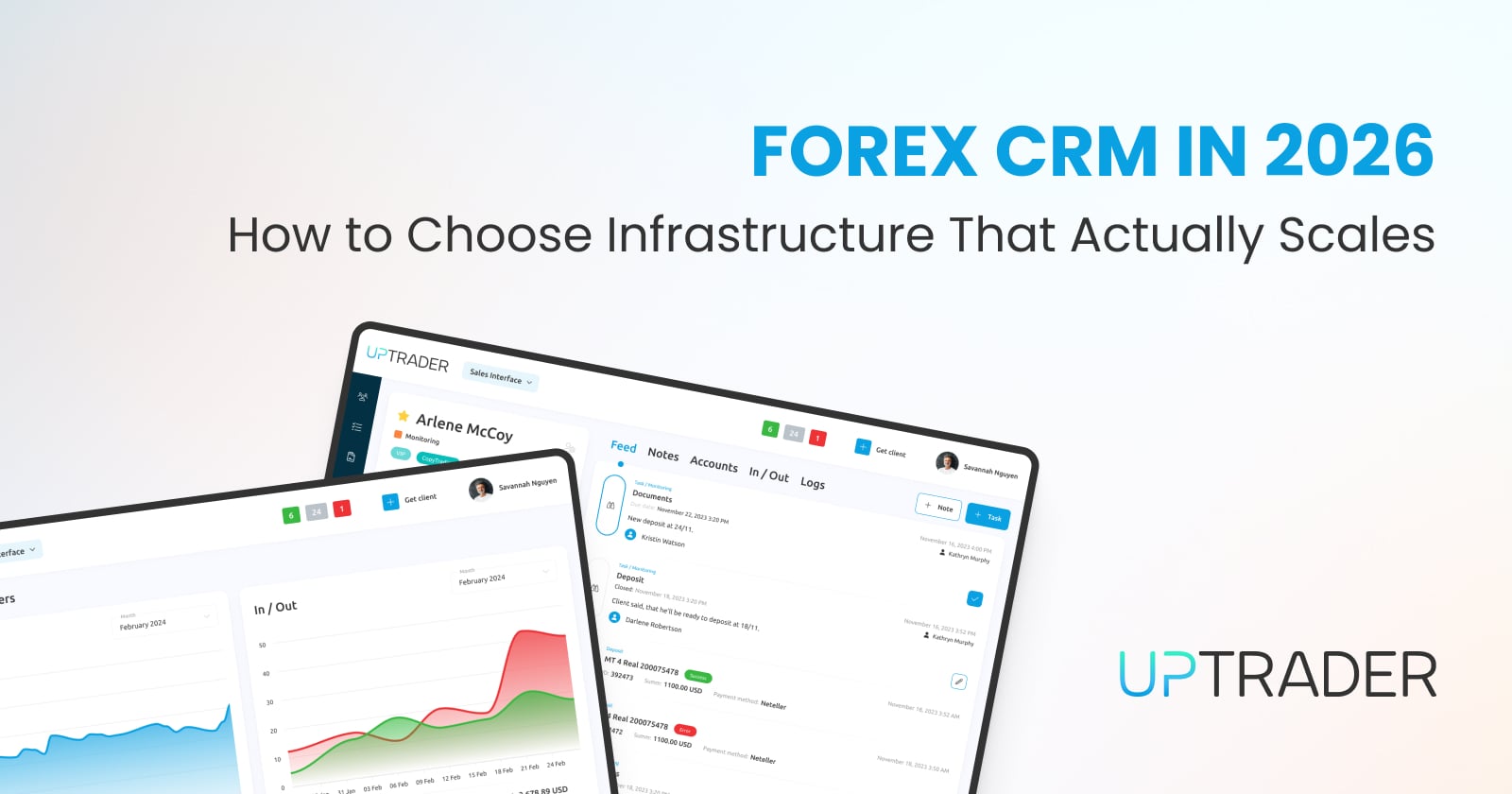
Forex CRM in 2026: How to Choose Infrastructure That Actually Scales
Share this publication:
If you are running a forex brokerage right now, you already know that your Forex CRM is not just a place where you store client contact details. It is the operational backbone of your entire business. It connects your onboarding flow to your compliance engine, your deposit processing to your IB management, and your retention workflows to your trading platform data. And if any one of those connections breaks under pressure, you feel it across every department at once.
The problem is that most brokers do not think about scalability until they are already scaling. You pick a Forex CRM that works well enough at launch, push through the first few hundred clients, maybe a thousand, and then the cracks start showing. KYC approvals bottleneck. Withdrawal queues pile up. Your IB commission calculations lag behind real-time activity. Reports take longer to generate. Sound familiar?
This is the reality of choosing infrastructure that was built for where you were, not where you are going. And in 2026, where regulatory scrutiny is tightening across every major jurisdiction and client expectations around speed and transparency keep climbing, you cannot afford to outgrow your own tech stack.
So how do you make the right choice from the start?
Stop Thinking About Forex CRM Features. Start Thinking About Architecture.
Here is where most brokers go wrong in the evaluation process. You sit through demos, you compare feature checklists, and you pick whichever platform ticks the most boxes. But a long feature list does not tell you anything about how those features perform when 5,000 concurrent users are hitting your client portal during a volatile session, or when your compliance team needs to process 300 KYC submissions in a single day because you just launched in a new region.
What you actually need to evaluate is the underlying architecture. Ask yourself whether the platform uses an event-based ledger system for transactions, or whether it relies on snapshot-based reporting that makes root-cause analysis nearly impossible during audits. Ask whether the Forex CRM can run multiple brands and multiple jurisdictions from a single instance, or whether scaling into a new market means deploying an entirely separate system. These are the questions that separate a tool you will use for six months from infrastructure you can build on for years.
A well-architected Forex CRM treats every deposit, every withdrawal approval, every KYC status change, and every IB commission event as a discrete, traceable record. When a regulator asks you who approved a specific withdrawal, which checks ran before that approval, and what the client's risk profile looked like at the time, your CRM should be able to answer that in seconds. If it cannot, you have a compliance vulnerability dressed up as a software limitation.
Trading Platform Integration with Forex CRM Is Non-Negotiable
You would be surprised how many brokers still operate with a Forex CRM that sits in a silo, disconnected from their MT4, MT5, or cTrader environment. When your sales and retention teams cannot see a client's real-time balance, open positions, or recent trading behavior directly inside the CRM, they are making decisions with incomplete information. That is not just inefficient. It is a direct contributor to client churn.
Deep trading platform integration means your Forex CRM can dynamically segment clients based on live activity. High-value traders, dormant accounts, and risk-flagged profiles should surface automatically, not through a manual export that somebody runs on Monday morning. This kind of visibility is what allows your team to act on data rather than react to problems after the damage is already done.
When evaluating a Forex CRM, ask specifically about the depth of integration. Does it pull account balances in real time? Does the platform allow you to create automatic workflow based on predefined trade volumes? Does it sync margin status or only basic information about an account? The key to your team's ability to work effectively at scale is the distinction between surface integration versus complete operational synchronization.
Compliance Should Be Embedded into Forex CRM, Not Bolted On
There is an elevated level of regulatory scrutiny placed on the foreign exchange marketplace, with no indications to change by 2026. Regardless of FCA oversight, multi-jurisdictional licensing, or complying with CySEC regulations, your CRM solution must provide you the functionality to meet compliance requirements natively instead of by bolting on compliance capabilities post-fact.
That means that your KYC and AML processes should be automatically facilitated through workflows that automate the routing of documents, flagging of discrepancies, and escalation of edge cases without your compliance staff continually providing input to complete each individual submission. It also means maintaining audit trails of every action supported by complete time stamping of the decision made, the action taken, and the person/who took action. And it means the ability to configure jurisdiction-specific rules without rewriting your entire workflow every time you expand into a new market.
Brokers who treat compliance as a separate system, handled by a different team using a different tool, are building operational risk into their growth model. The more fragmented your compliance infrastructure, the harder it becomes to maintain consistency as volume increases. Centralized compliance within your Forex CRM is not a luxury. It is the only defensible approach when regulators come knocking.
Forex CRM Automation That Is Governed, Not Just Fast
Automation is everywhere in modern Forex CRM marketing copy. Every vendor promises to automate your onboarding, automate your communications, automate your IB payouts. But speed without governance is a liability.
What you should look for is controlled automation, where every automated action follows predefined rules, remains auditable, and can be reviewed after the fact. If your Forex CRM auto-approves a withdrawal based on certain conditions, you need a clear record of what those conditions were, when they were last updated, and who authorized the rule. If an IB commission is calculated and paid automatically, you need to trace that calculation back to the underlying trade data.
This is especially critical as you grow your team. New agents should be able to follow standardized workflows from day one without needing weeks of training or tribal knowledge from senior staff. Controlled automation creates that consistency. It keeps your operations aligned across regions, across departments, and across experience levels.
The Wallet and Payment Layer of Forex CRM Matters More Than You Think
Payment processing is one of those areas that seems straightforward until it is not. Deposits, withdrawals, internal transfers, multi-currency wallets, PSP integrations. When your Forex CRM does not provide full visibility into this layer, you end up with reconciliation headaches that consume hours of your finance team's week.
A scalable FX CRM should give you a single-wallet ledger architecture where every fund movement is recorded as a discrete event tied to a specific client identity. This eliminates the fragmentation that happens when you track per-account or per-PSP balances independently. At low volume, the difference is negligible. At scale, it is the difference between a 15-minute reconciliation and a two-day investigation.
You should also evaluate how many payment service providers the Forex CRM supports natively. If PSP integration is available out of the box, you will need less custom development to handle regional payment preferences as you expand.
What About Prop Firm Operations?
If you are running a hybrid model that includes proprietary trading alongside traditional brokerage services, your Forex CRM needs to handle both. Challenge management, evaluation tracking, funded account operations, and the distinct compliance requirements that come with prop trading are all workflows that a purpose-built FX CRM should support without requiring a second platform.
The explosive growth of prop firms over the past two years means that Forex CRM vendors are increasingly building dedicated modules for this segment. If prop trading is part of your roadmap, evaluate whether the Forex CRM can manage those workflows natively or whether you would be stitching together workarounds.
Frequently Asked Questions
Can I use a general-purpose CRM like Salesforce or HubSpot for my forex brokerage?
You can, but you will spend significant time and money customizing it to handle trading platform integration, multi-currency wallet management, IB hierarchies, and compliance workflows that are standard in purpose-built FX CRM platforms. Most brokers who start with generic tools end up migrating within 12 to 18 months once operational complexity exceeds what the platform was designed for.
How much does Forex CRM software typically cost?
Pricing varies widely depending on your brokerage stage. SaaS subscriptions for newer brokers generally start around $500 per month for basic configurations. Mid-market deployments typically fall in the $2,000 to $10,000 per month range depending on modules and integrations. Enterprise-level implementations can involve one-time setup fees of $10,000 to $50,000 or more alongside monthly platform costs.
What is the single most important factor when choosing a Forex CRM?
Architectural alignment with your operating model. A Forex CRM that mirrors how your brokerage actually works on a daily basis, connecting onboarding, compliance, funding, partner management, and trading visibility into a unified system, will outperform a feature-rich platform that forces you to adapt your operations to its structure.
The Bottom Line
Choosing an FX CRM in 2026 is not a software purchase. It is an infrastructure decision that will shape how your brokerage operates, scales, and defends itself under regulatory scrutiny for years to come. Stop evaluating platforms based on feature counts and start evaluating them based on architectural fit, integration depth, compliance maturity, and the ability to govern automation at scale. Your future self, and your compliance team, will thank you.
UpTrader provides a fully integrated Forex CRM and back-office platform built specifically for brokerages that need to scale without compromising on compliance, transparency, or operational control.
See how UpTrader can support your growth here.